
The Future QA Engineer Won’t Write More Tests. They’ll Ask Better Questions.
The Future QA Engineer Won’t Write More Tests. They’ll Ask Better Questions.
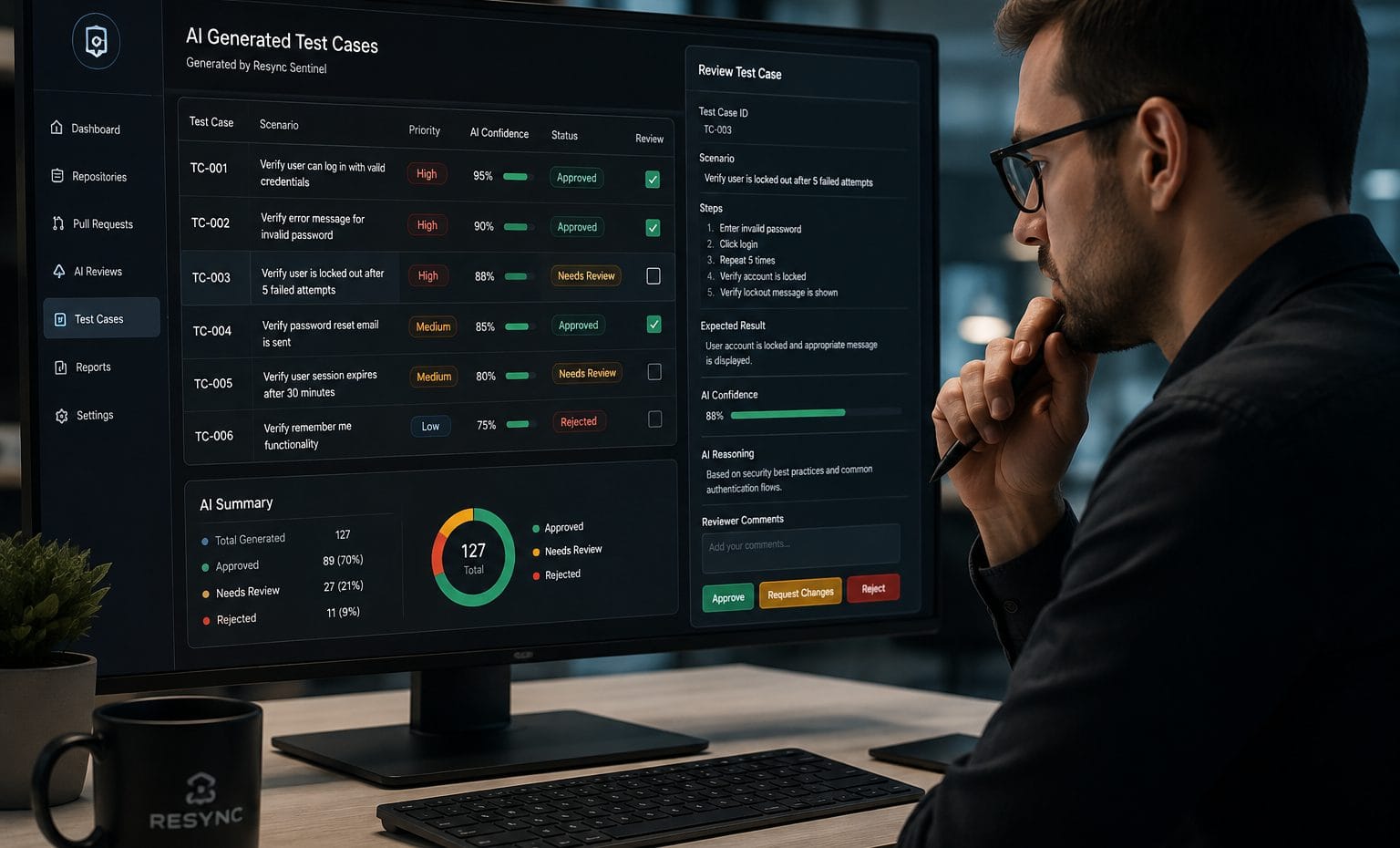
We Hire QA Engineers Across New Zealand’s Most Complex Programmes. The Job Description Has Changed.
At Resync, we’ve placed quality engineers inside banking migrations, government platforms, telco transformations, and critical infrastructure programmes. We’ve watched the role evolve in real time — and the shift happening right now is the most significant one we’ve seen.
The traditional measure of a strong QA engineer was volume. Test cases written. Coverage percentages hit. Regression matrices maintained. That era is ending — not because quality matters less, but because the mechanical work of producing test coverage is becoming something AI does well, fast, and cheaply.
Give a modern AI model a user story, an API contract, or a codebase, and it will produce a credible first draft of test coverage before most engineers have finished their morning coffee. The bottleneck is no longer who will write the tests. It is what we should actually be testing, and why it matters enough to test at all.
That shift changes everything about how we think about the role.
AI Writes the Tests. Humans Identify the Risks.
Machines are excellent at pattern matching and exhaustive enumeration. They are poor at judgement under uncertainty.
AI does not sit in the room when a programme director says “this feature has to ship before the board meeting.” It does not notice the quiet assumption that a payment flow will behave identically for a rural customer on a low-bandwidth connection as it does in a Wellington office. It does not instinctively ask:
- Which part of this system creates the highest business risk if it fails?
- Where are the hidden dependencies that no one has written down?
- What does “good enough” actually mean for this release, given the audience and the stakes?
- What happens when the third-party integration we depend on returns a partial failure at 11 pm on a Saturday?
Those questions belong to humans — and specifically, to humans who have no stake in answering them comfortably.
That last part matters. A development team testing its own work is unlikely to ask the questions that make everyone in the room uncomfortable. An independent QA team has no reason not to.
The future QA engineer is less a test author and more a risk detective. Their primary skill is not Selenium syntax or Playwright fluency. It is the ability to interrogate a design, a requirements document, or a live system and surface the failure modes that matter most before they reach production.
What We’re Looking For Has Changed
When we assess QA engineers at Resync today, we’re less interested in how many test cases someone can write and more interested in how they think.
Can they look at a feature and immediately identify the three scenarios that will make everyone in the room slightly uncomfortable? Can they translate vague product goals into precise failure conditions? Can they decide which risks deserve expensive human attention and which can safely be delegated to automation?
Can they work with AI as a genuine force multiplier — feeding it the right context, reviewing its output critically, and knowing when the output is confidently wrong?
Those skills require domain knowledge, systems thinking, and the confidence to challenge assumptions. They also require something no automation framework provides: the independence to say what’s actually true about the quality of a system, even when that’s not what the delivery team wants to hear.
What This Means for Clients
Organisations that measure QA by test-case volume will keep hiring people who compete with AI on the tasks AI is already winning. They’ll also keep getting the kind of quality assurance that catches the bugs that weren’t the real problem.
The programmes we see succeed are the ones where QA is engaged before the code is written — where risk mapping happens at the design stage, where testers, architects, and product owners are in the same room asking hard questions early enough that the answers actually change something.
That is not a role AI fills. It is a role that requires judgement, experience, and independence.
We’ve been doing this work across New Zealand’s most demanding programmes for years. What’s changing is not the need for quality. What’s changing is what quality assurance actually looks like when it’s done well.
The best QA engineers of the next decade won’t produce the longest test suites. They’ll ask the questions that protect the programme — and they’ll ask them early enough to matter.
Resync is New Zealand’s independent QA consultancy. We test what others build.